|
|
|
High
Stile
Location: Lake
District,
Western Fells
Grid Ref: NY
170148
Height: 2648 ft (807
m)
Status: Wainwright,
Marilyn,
Hewitt, Nuttall
Notes: The highest
of the
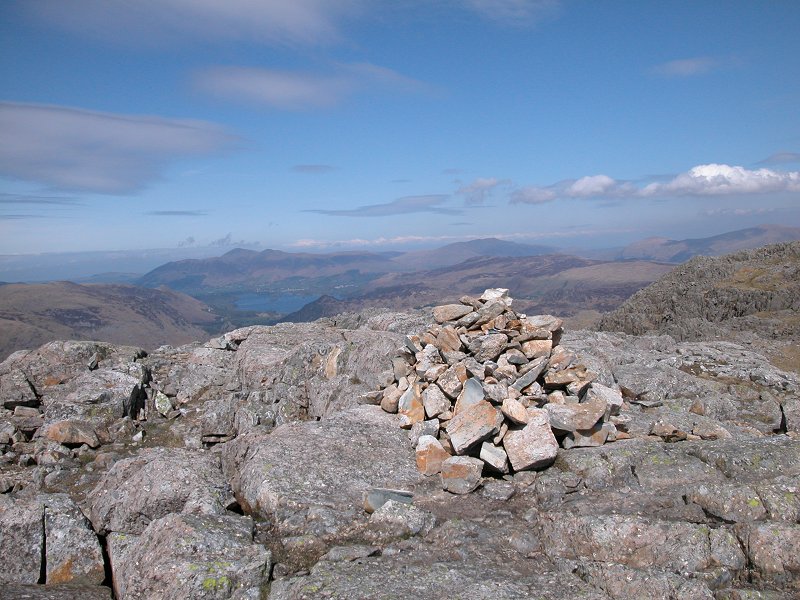
trio of fells standing high over Buttermere, High Stile is a superb
viewpoint
but is also a fell that is not easily won. It can be rarely climbed on
its own, almost all visits being made by those walking the ridge as a
whole
and approaching by either Red Pike or High Crag. Both these fells have
steep and slightly tricky ascents that require a good deal of effort,
although
the ridgewalk itself is straightforward and delightful.
|
|
|
High
Tove
Location: Lake
District,
Central Fells
Grid Ref: NY
289165
Height: 1689 ft (515
m)
Status: Wainwright
Notes: High Tove
is one of
the summits of Lakeland's Central Fells ridge, which stretches north
from
the Langdale Pikes to the Keswick - Penrith gap. The ridge is atypical
of Lakeland, being low and marshy. Although situated midway between
Borrowdale
and Thirlmere, High Tove overlooks neither. The far panorama is
pleasant
enough, however, and includes the Dale Head, Helvellyn and Skiddaw
groups.
High Tove can easily be climbed from Watendlath in about half an hour,
the old path over to Thirlmere crossing the ridge via the summit.
|
|
 |
Hindscarth
Location: Lake
District, North Western Fells
Grid Ref: NY
215165
Height: 2385 ft (727
m)
Status: Wainwright,
Hewitt, Nuttall
Notes: Hindscarth is
the second of the three fells that overlook
Honister Pass from the north. From this side Robinson, Hindscarth and
Dale Head form a continuous wall above the pass, but the system of
valleys and ridges that differentiate them from each other is well seen
from the Newlands valley to the northwest. Hindscarth is rarely climbed
on its own, but usually in conjunction with either Robinson or Dale
Head, from either of which it's but a simole ridgewalk away. The summit
stands off the main ridge to the north and provides an excellent view.
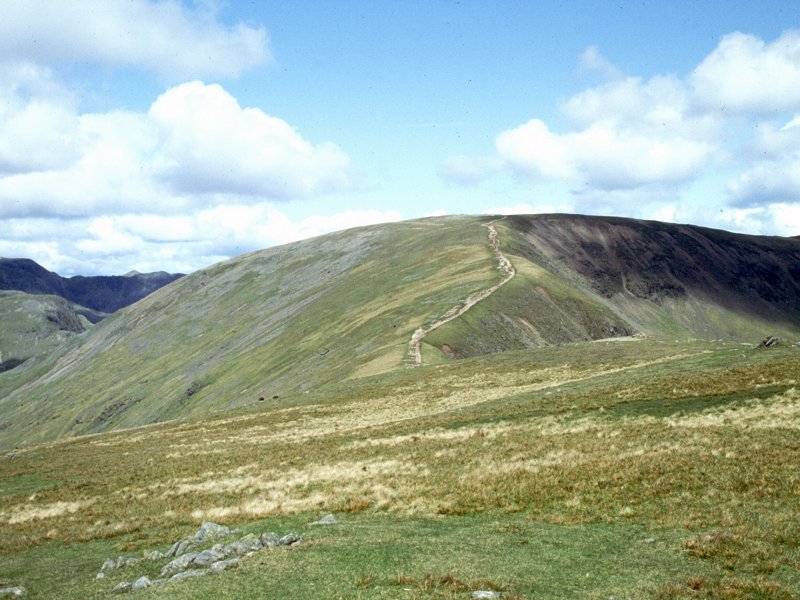
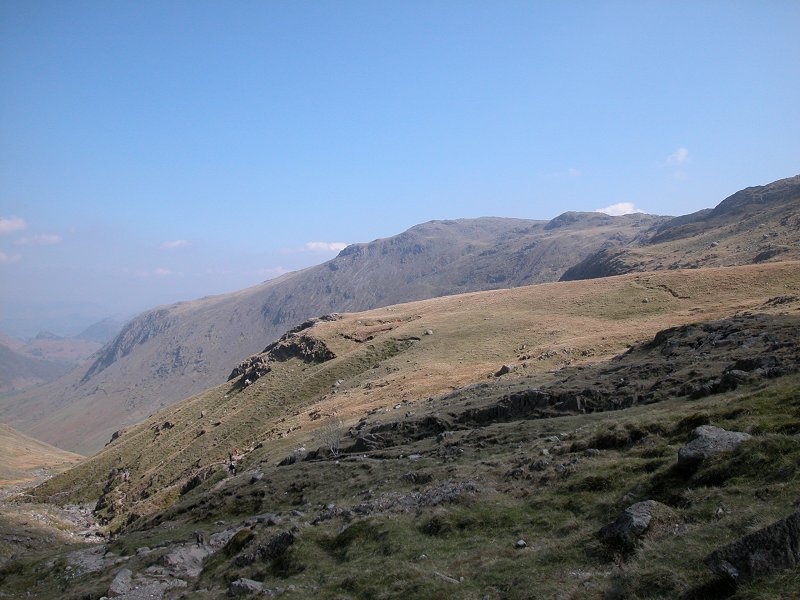
In the picture we're looking southwards across the Dale Head col
towards the Scafell range and Great Gable. |
|

|
Holme
Fell
Location: Lake
District,
Southern Fells
Grid Ref: NY
315006
Height: 1040 ft (317
m)
Status: Wainwright,
Marilyn, Clement
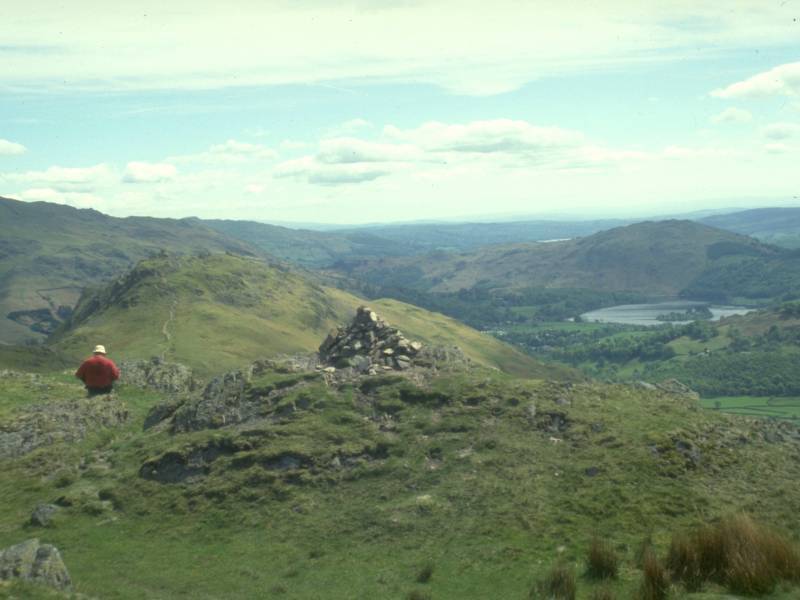
Notes: A rambling and
rugged little fell, overlooking the head of Coniston Water. A
mile or so northwest of Tarn Hows, it's perhaps best climbed from the
road junction at Yew Tree Farm via Uskdale Gap. Although the Coniston
fells crowd the view to the southwest the panorama in most other
directions is extensive and rewarding.
|
|
 |
Ill
Bell
Location: Lake
District,
Far Eastern Fells
Grid Ref: NY
436077
Height: 2484 ft (757
m)
Status: Wainwright,
Hewitt, Nuttall
Notes: Ill Bell is
the highest top on the ridge between Troutbeck and Kentmere. It is seen
as a shapely pyramid from most aspects and ascents to it from any
direction are quite steep. It is normally climbed as part of the
Kentmere horseshoe via Yoke or Froswick. The Fairfield and Helvellyn
ranges dominate the panorama to the northwest, with Gable, Scafell,
Bowfell and the Langdale Pikes crowding in to the west. Windermere is
well seen to the southwest. |
|


|
Ingleborough
Location: Yorkshire
Dales,
Ribblesdale
Grid Ref: SD
740745
Height: 2372 ft (726
m)
Status: Marilyn,
Hewitt,
Nuttall
Notes: One of the
famous Three
Peaks of the Yorkshire Dales National Park, Ingleborough stands to the
west of Horton-in-Ribblesdale. Its characteristic flat top makes it
stand
out for many miles around, and it is even prominent from many of the
Lakeland
fells forty miles away. There are many well trodden routes to the
summit
though perhaps the best are those from Clapham and
Horton-in-Ribblesdale.
The view is superb, while the flanks of the fell are packed with
interest,
including potholes and caves (among them the famous Gaping Gill),
limestone
pavements, and waterfalls. There are enough footpaths in the environs
of
the fell to keep you exploring for a month.
|
|
 |
Kinder
Scout
Location: Peak
District, Derbyshire
Grid Ref: SK
085875
Height: 2088 ft (636
m)
Status: Marilyn,
Hewitt,
Nuttall, County Top (Derbyshire)
Notes: The highest
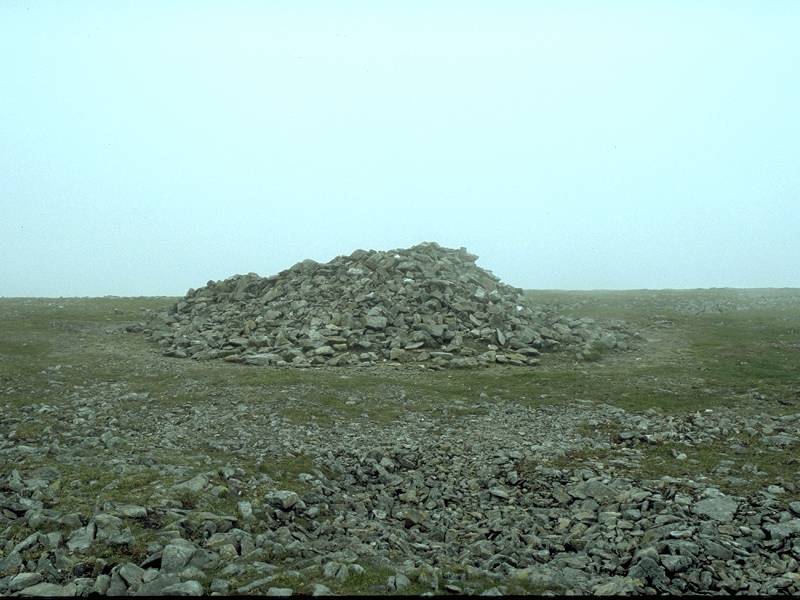
summit of the Peak District is a desolate spot in the middle of a huge
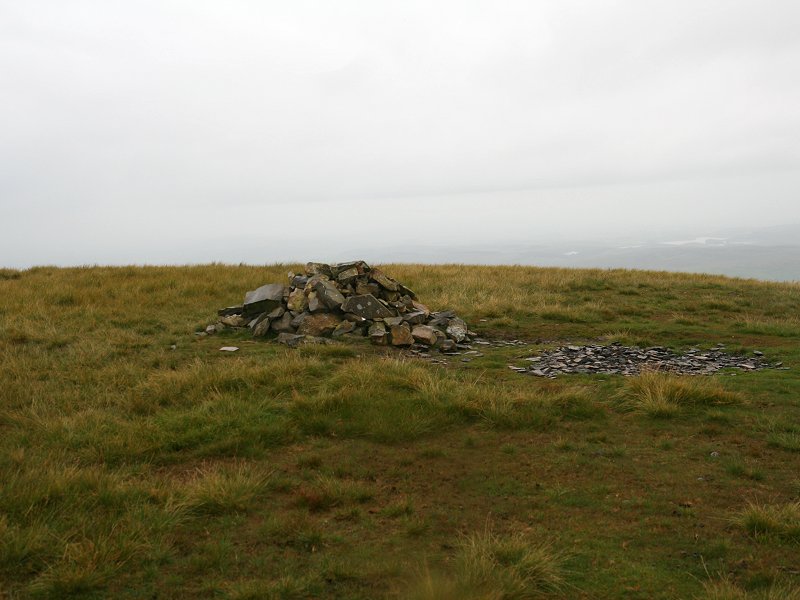
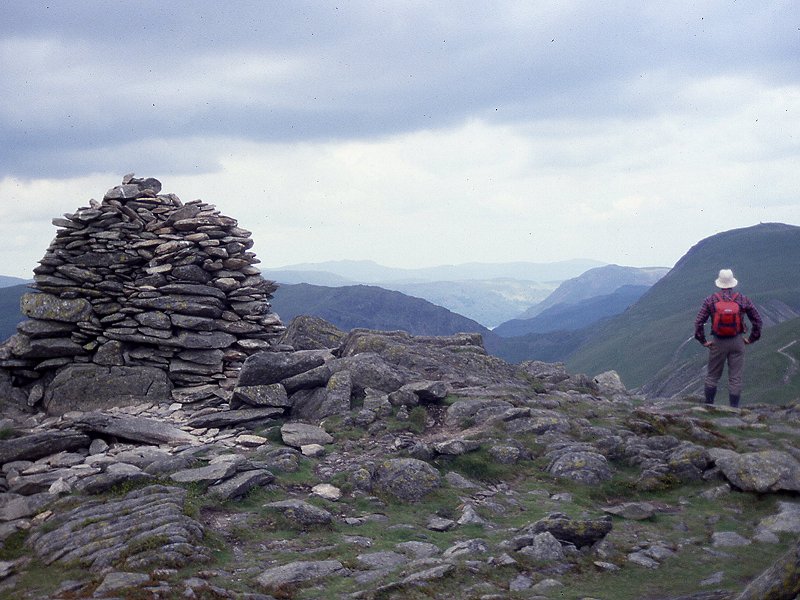
peat bog. The cairn pictured here may or may not be the actual summit
but it really matters little - Kinder Scout is a vast, flat plateau
with little variation in height, and the cairn must mark something or
other. It can have few visitors, for although the Pennine Way runs
across Kinder it misses the actual top by about half a mile. I took
this picture in September 1975 after several months of drought and I
was wearing ordinary street shoes at the time, a feat impossible in
normal conditions. |
|


|
Kit
Hill
Location: Bodmin
Moor, Cornwall
Grid Ref: SX
374713
Height: 1096 ft (334
m)
Status: Marilyn
Notes: A detached
outlier of Bodmin Moor, Kit Hill stands some ten miles north west of
Plymouth and directly above the market town of Callington. Approaches
from the town are not straightforward and the best starting point is
probably the village of Kelly Bray to the west. The hill is a broad
dome of heathland and much of it has been designated a country park. A
tall brick communications tower stands at the summit, and a road also
runs to the top. Extensive earthworks suggest an iron age hill fort.
Views are pleasant but not extensive; Caradon Hill is seen to the west,
Dartmoor to the east. The summit view picture shows Kelly Brae to the
west. |
|


|
Knock of Crieff
Location: Scottish
Highlands, Perthshire
Grid Ref: NN
873233
Height: 915 ft (279
m)
Status: Marilyn
Notes: Knock of
Crieff is a splendid little hill that overlooks the Perthshire town of
Crieff. The lower top has a viewpoint and a topograph; the upper top
lays deep within the trees and is marked by a cairn. The ascent is easy
and is a delightful evening stroll from the town. From the lower
viewpoint one can gaze upon the Ochils to the south, Ben Vorlich to the
west, and Ben Chonzie and Auchnafree Hill to the northwest and north.
|
|
 |
Knott
Location: Lake
District,
Northern Fells
Grid Ref: NY
296329
Height: 2329 ft (710
m)
Status: Wainwright,
Marilyn, Hewitt, Nuttall
Notes: The highest
top of the Caldbeck or "Back O' Skiddaw" massif, Knott is sprawling and
remote. Perhaps the best approach is along the single track road from
Mosedale and the path along the north side of Grainsgill Beck. Although
much of the surrounding moor is covered in heather, Knott itself
features a beautiful grassy top. Knott's "middle of nowhere" situation
is magnificent but as a consequence its view does lack interest, being
largely composed of endless miles of empty moorland. |
|

|
The
Knott
Location: Lake
District, Far Eastern Fells
Grid Ref: NY
437127
Height: 2425 ft (729
m)
Status: Wainwright
Notes: The Knott
looks like a significant fell when you approach it from the west, but
in reality is is a mere pimple on the ridge between High Street and
Rest Dodd, and it can be climbed from the intervening col in just two
minutes. The col carries the path from Ullswater to High Street (part
of Wainwright's Coast to Coast Walk) and this is the obvious ascent
route. The High Street ridge dominates the view to the east, Ullswater
is seen to the north, the Helvellyn group to the east and Stony Cove
Pike to the south. A grand mountain panorama.
|
|


|
Latrigg
Location: Lake
District,
Northern Fells
Grid Ref: NY
278246
Height: 1207 ft (368
m)
Status: Wainwright
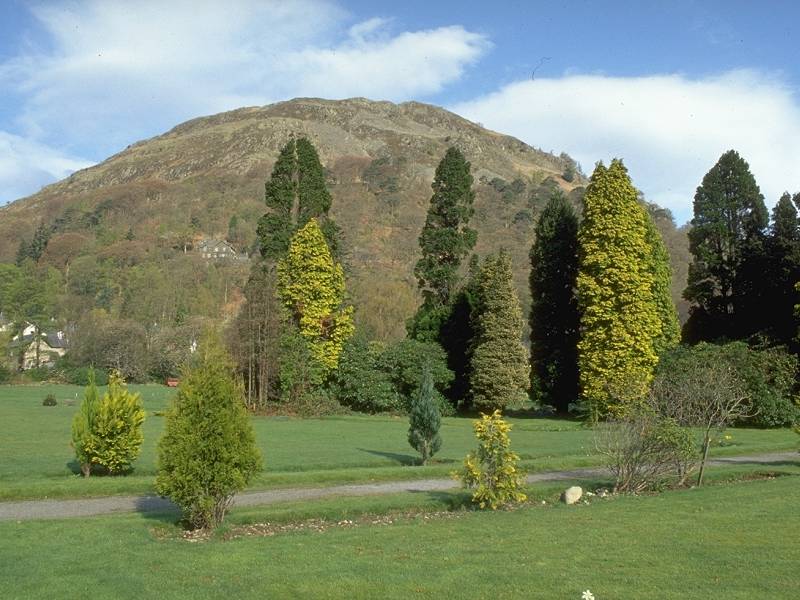
Notes: Latrigg is
Keswick's
local fell and stands immadiately above the town to the north. It is
rather
dwarfed by Skiddaw, of which it is really just an outlier, but
nevertheless
it's a bit of a magnet to the town's visitors. Its slopes are quite
extensively
wooded, and like many of the lower fells it is relatively steep and
needs
a fair bit of effort to climb. The easiest way up is to set out along
the
Skiddaw path from Spooney Green Lane and head almost as far as the
Latrigg
- Skiddaw col, from where the top of Latrigg is a relatively easy
stroll.
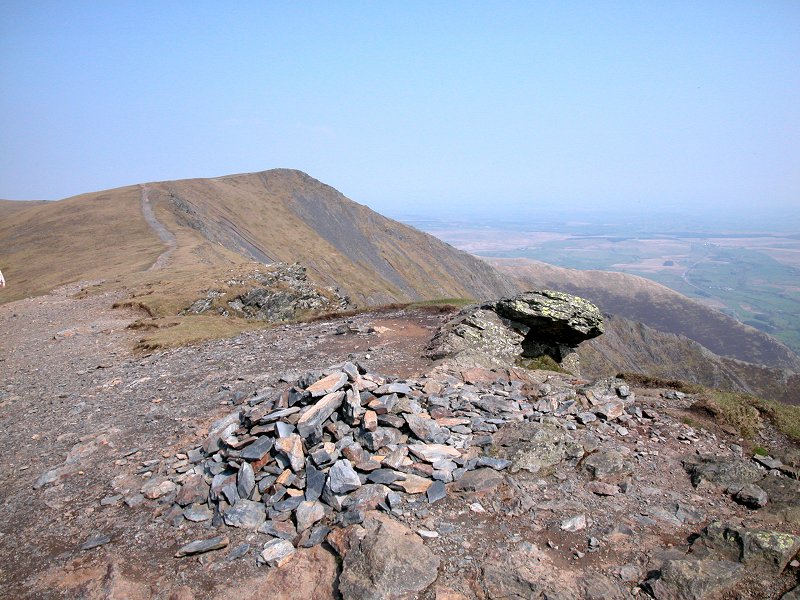
There is no trig point, marker or cairn on the highest point (seen
left).
The principal viewpoint is a few hundred metres west of the highest
point
and has excellent views of Keswick, Derwentwater, Skiddaw, and the
Grasmoor
and Dale Head groups.
|
|

|
Laughter
Tor
Location: Dartmoor
Grid Ref: SX
653757
Height: 1381 ft (421
m)
Status: Clement
Notes: One of
Dartmoor's many tors, Laughter Tor is easy enough to climb though it's
an hour or so from Postbridge, its most convenient access point. It is
usually climbed along with its near neighbour, Bellever Tor. The view
is not extensive but if you like endless vistas of empty moorland then
Laughter Tor is for you.
|
|
|
The Law
Location: The
Ochils
Grid Ref: NS
910996
Height: 2093 ft (638
m)
Status: Donald top
Notes: The Law is
an outlier
of Ben Cleuch, the highest top of the Ochils, and lays directly along
the
path to the parent fell from Tillicoultry. The cairn is actually just
across
the fence from the path but it would take a real purist to claim that
the
hill was not "bagged" unless one had slid across the fence to touch the
cairn proper. Views over the plain of the Forth are superb.
|
|
|
Leith
Hill
Location: North
Downs, Surrey
Grid Ref: TQ
139431
Height: 968 ft (295 m)
Status: Marilyn,
County
Top (Surrey)
Notes: Leith Hill
is the highest
point in south east England, the summit of an area of heath and forest
laying proud of the North Downs a few miles southwest of Dorking. The
tower
is an eighteenth century folly built in an effort to raise the height
of
the hill to 1000ft. Due to the tree cover there is no view from the
summit
although a good sweep of the North Downs can be seen from a point a few
hundred metres to the northeast. The nearest road access is the hamlet
of Coldharbour, a mile away, while the nearest rail access is Holmwood
on the London Victoria to Horsham line. The hill can be climbed from
Holmwood
in about 50 minutes by using a combination of lanes and local footpaths.
|
|
|
Ling
Fell
Location: Lake
District,
North Western Fells
Grid Ref: NY
179285
Height: 1224 ft (373
m)
Status: Wainwright
Notes: Like its
neighbour
Sale Fell, Ling Fell is a grassy hill on the northwestern edge of the
Lake
District. Its position gives it a good view over the Vale of Lorton and
Cockermouth, and beyond to Scotland across the Solway Firth. It can be
ascended with relative ease from the Kelswick farm road above Embleton.
|
|

|
Lingmoor
Fell
Location: Lake
District, Southern Fells
Grid Ref: NY
302046
Height: 1539 ft (469
m)
Status: Wainwright,
Marilyn
Notes: An
isolated fell laying between Langdale and Little Langdale, Lingmoor is
of modest height yet great complexity. Its slopes are steep and its
summit ridge is both rocky and boggy and, despite it being one of those
fells habitually left for a mediocre day, it is not a place to be in
poor weather. Best approached from the unclassified road between
Dungeon Ghyll and Little Langdale, Lingmoor is a prime viewpoint for
the Langdale Pikes (another reason to visit in good weather). There's
an awesome closeup view of Bowfell and its neighbours to the west,
while eastwards the Fairfield and Helvellyn ranges dominate.
|
|
 |
Little
Calva
Location: Lake
District,
Northern Fells
Grid Ref: NY
282314
Height: 2106 ft (642
m)
Status: Nuttall
Notes: A minor top
west of Great Calva. Were it not for its status as a Nuttall it's
doubtful if anyone would ever seek out this fell top, situated as it is
in the midst of a boggy and dreary sea of heather. It wasn't until I
got home that I noticed the rain on the camera lens, but unfortunately
this image will have to do as I seriously doubt I'll ever come here
again. The best approach is probably from Great Calva, from which there
is a path of sorts, a splendid expedition for those who enjoy wading
through soup. The view is about as exciting as the fell itself. Best
visited in sunshine when at least the situation of being well off the
beaten track can be enjoyed. |
|


|
Little Dun
Fell
Location: North
Pennines,
Cumbria
Grid Ref: NY
704330
Height: 2762 ft (842
m)
Status: Hewitt,
Nuttall
Notes: Little Dun
Fell is
one of the Cross Fell group of summits in the north Pennines, and is on
the route of the Pennine Way. The PW is the normal route of ascent to
the
summit, though it could also be climbed by way of the private road to
the
summit of its neighbour, Great Dun Fell. There is not a great deal to
commend
the summit as a viewpoint; much of the panorama consists of the wild
high
ground of the Pennines, though the Lakeland Fells crowd the skyline to
the southwest.
|
|


|
Little
Hart
Crag
Location: Lake
District,
Eastern Fells
Grid Ref: NY
387100
Height: 2090 ft (637
m)
Status: Wainwright,
Hewitt,
Nuttall
Notes: Little Hart
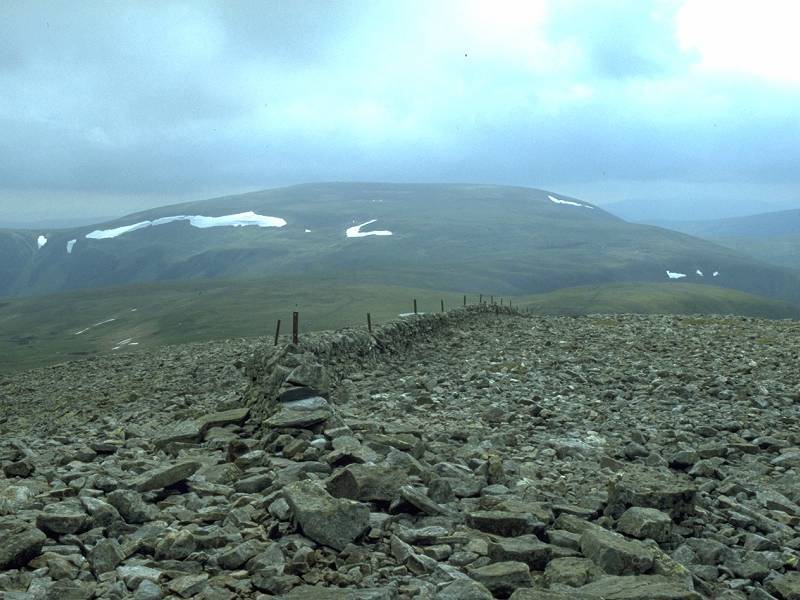
Crag is
effectively an eastern outlier of Dove Crag. It's a fearsome looking
summit,
a crown of crags standing above the head of Scandale, but is far less
daunting
than it looks. It can be climbed from the Scandale col in fifteen
minutes.
It is excellently placed for close-up views of Red Screes (to the east)
and Dove Crag and Fairfield (to the west) but the bulk of these hills
does
rather tend to shut out the wider panorama. |
|
 |
Little
Lingy Hill (a.k.a. Iron Crag)
Location: Lake
District, Northern Fells
Grid Ref: NY
303338
Height: 1998 ft (609
m)
Status: none
Notes: Laying to the
west of Great Lingy Hill and a minor "Top" of Caldbeck's High Pike,
Little Lingy Hill is a more prominent and better defined hill than its
big brother but is just two feet short of qualifying as a Nuttall.
Strictly the summit itself is nameless - Iron Crag is a rock formation
on its north slopes and the map places the legend "Little Lingy Hill"
almost at the col between here and Knott. The summit lacks interest
apart from the view out across the Solway firth, and there are no paths
anywhere near it. The hill itself looks quite handsome from down in the
valley, however, towering above the gash of Dale Beck south of Fell
Side. |
|

 |
Little Mell
Fell
Location: Lake
District,
Eastern Fells
Grid Ref: NY
423240
Height: 1657 ft (505
m)
Status: Wainwright,
Marilyn
Notes: Little Mell
Fell is
the lesser companion of Great Mell Fell, and like its big brother it's
an isolated grassy dome laying north of Ullswater and east of
Matterdale.
Its portrait to the left is from neighbouring Gowbarrow Fell. There is
a permissive path to the summit from The Hause, below its southern
flank
where it meets Little Meldrum (an outlier of Gowbarrow Fell). Ullswater
is not well seen from the summit, and the better views are to the west
and south west where the Fairfield and Helvellyn groups, the Dodds and
Great Mell Fell look very inviting. On a clear day the high tops of the
north Pennines should be in view to the northeast.
|
|

|
Loadpot
Hill
Location: Lake
District, Far Eastern Fells
Grid Ref: NY
456181
Height: 2201 ft (671
m)
Status: Wainwright,
Hewitt, Nutall
Notes: Loadpot Hill
is the northernmost hill of the High Street ridge. The ridge falls
northwards towards Pooley Bridge and this is the most obvious ascent
route if you're climbing Loadpot for its own sake, though it is usually
climbed as part of the ridgewalk. Masochists might try the very steep
ascent from Howtown. The view is not terribly exciting save for the
southwestern arc, which contains the head of Ullswater and the
Helvellyn group. The Vale of Eden fills the northern and eastern
panoramas, with the high Pennines visible to the northeast.
|
|


|
Lochnagar
(Cac Carn Beag)
Location: Scottish
Highlands,
Mounth
Grid Ref: NO
243861
Height: 3789 ft (1155
m)
Status: Munro, Murdo,
Marilyn
Notes: A superb
mountain, the highest summit of the Mounth, Lochnagar is not only a
pleasure to walk but also posesses dramatic features. Its summit
plateau is one of the largest tracts of high ground in the UK and, on
its northern lip, it falls away in a series of cliffs towards Loch
Nagar (from which the mountain is named). The highest summit, Cac Carn
Beag, sits above the western end of these cliffs. The most popular
ascent is from the Spittal of Glenmuick, southwest of Ballater, and
takes roughly three hours. The panorama is magnificent and features a
mountainscape ranging through the Fife hills in the south, the Mounth
and Perthsire hills to the west and the Cairngorms to the north. The
hills and plains of Aberdeenshire are seen to the east and there are
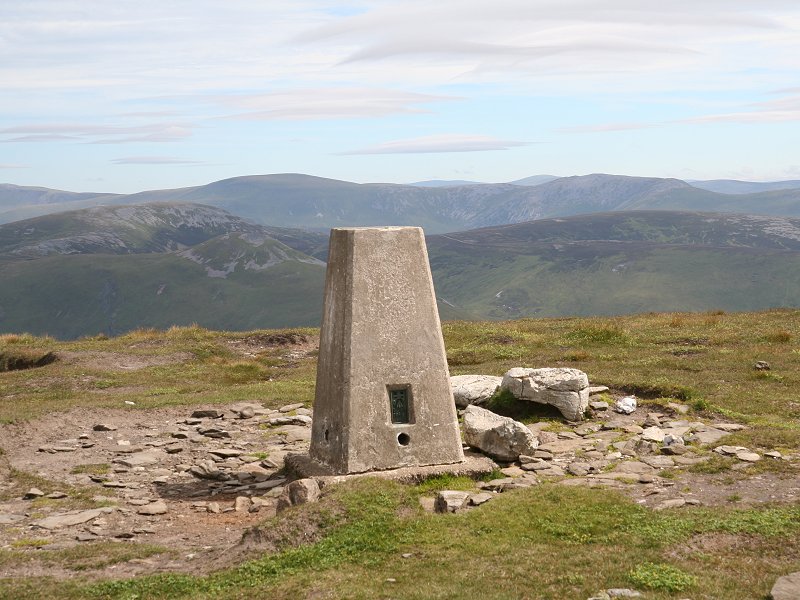
occasional glimpses of coastline. The summit features a topograph as
well as the usual Ordnance Survey trig pillar. |